
Köppen Climate Classification System
The most widely used system for categorizing the world’s climates is the Köppen Climate Classification. This system was devised by the German climatologist Wladimir Köppen in the early 20th century, using data on temperature, precipitation, and their seasonal distribution as the primary criteria.
Test Your Knowledge
[Explore all MCQs] [Climate Change MCQs] [Crop and Environment MCQs] [Environmental Science MCQs] [Forestry, Range Management & Wildlife MCQs]
The Köppen classification system is designed to reflect the close relationship between climate and regional vegetation; therefore, it is very useful in agriculture, ecology, geography and environmental studies.
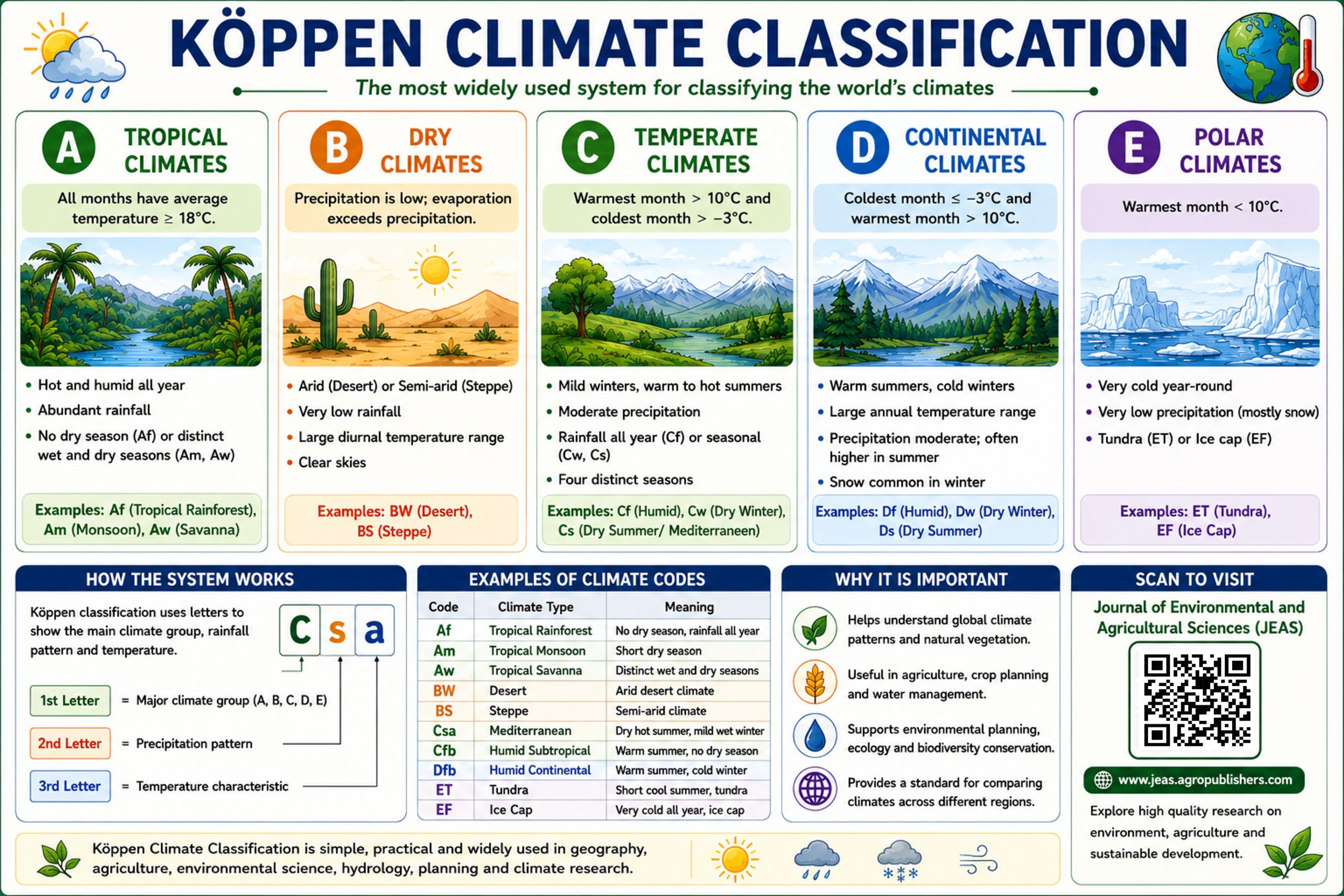
Five major climate groups in Köppen classification
The Köppen classification is a system of five main climate types (Groups), indicated by letters A, B, C, etc.
Group A (Tropical climates): Hot and humid areas where the average monthly temperature for the whole year is above 18°C.
Group B (Dry climates): Deserts and steppes with more evaporation than precipitation
Group C (Temperate climates): Mediterranean and humid subtropical climates
Group D (Continental climates) is characterized by warm summers and cold winters and is mostly found in the interiors of continents.
Group E (Polar climates): Tundra and ice-cap regions with consistently low temperatures are included.
How to identify Köppen climate type?
A combination of two or three letters is used to identify each type of climate. The first letter represents the major climate group, the second letter is an indicator of the seasonal precipitation pattern (dry summer or dry winter), the third letter describes the temperature features (hot or chilly summers).
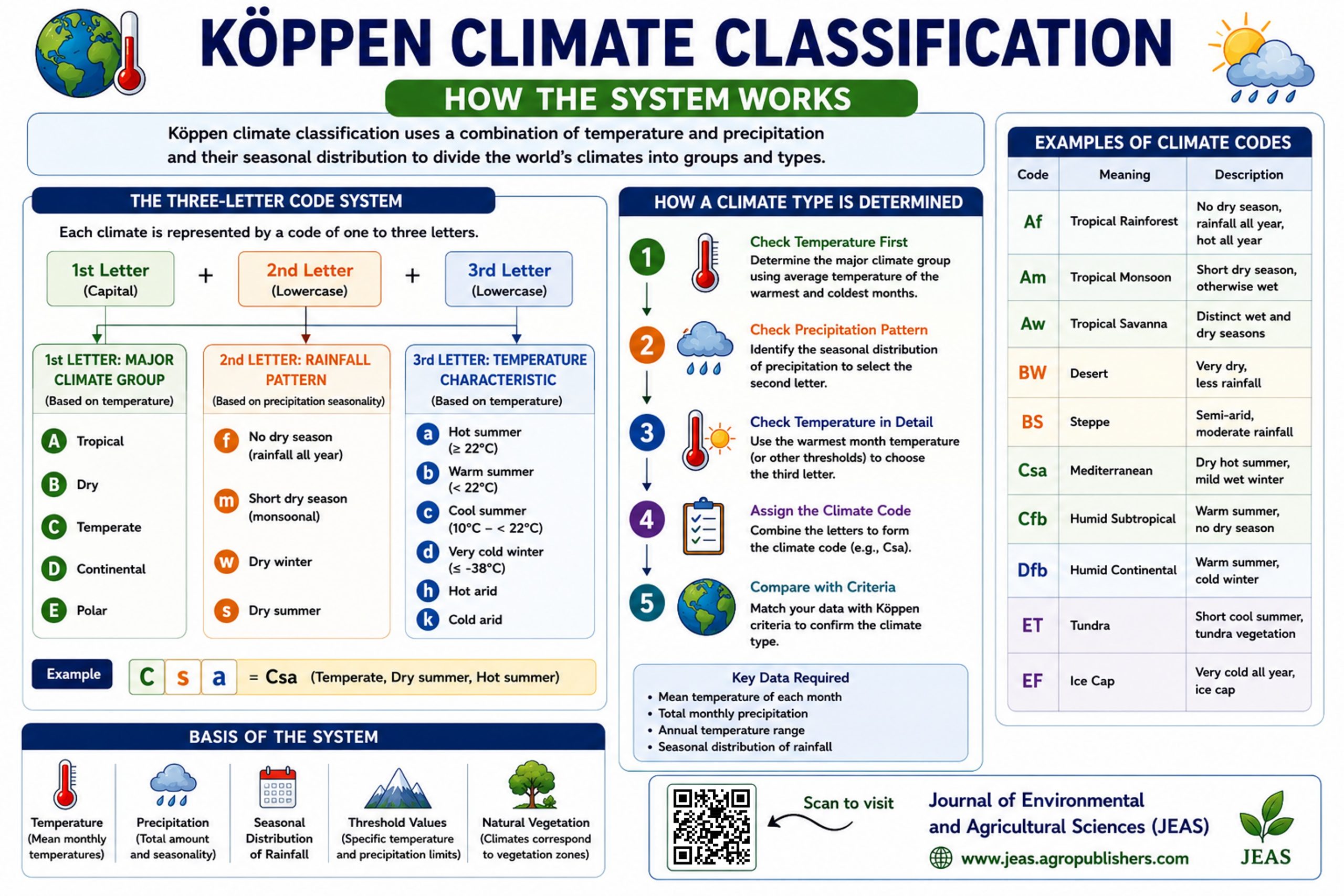
For example Af represents a tropical rainforest climate, and Csa represents a Mediterranean climate with hot, dry summers.
The Köppen system is widely used in agriculture, forestry, hydrology, protection of biodiversity, climate modelling and environmental planning. The Koppen classification is used to help scientists’ understanding of the distribution of vegetation, to compare climates from place to place and to assess potential climate change impacts. Although it may not adequately describe other factors such as altitude, wind patterns and incidence of extreme weather events, it has been used continuously as an international standard for characterising global climate patterns mainly due to its simplicity, consistency and usefulness.
Test Your Knowledge
[Explore all MCQs] [Climate Change MCQs] [Crop and Environment MCQs] [Environmental Science MCQs] [Forestry, Range Management & Wildlife MCQs]
What is Climate?
Climate is the long-term average pattern of weather conditions in a given area over a 30-year or longer period. Average temperature, precipitation, humidity, wind, air pressure, and seasonal changes are all included. Climate is the average of the weather conditions over a long time, while weather is the conditions of the atmosphere for a shorter time.
According to the World Meteorological Organization’s definition (WMO), climate is the statistical description of the average of important meteorological variables and their variability over a period of time, typically from months to thousands or even millions of years. Simply, climate is the long-term statistical behaviour of the atmosphere in a particular region.
Who developed the Köppen Climate Classification system?
The German botanist and climatologist Wladimir Köppen (1846–1940) developed the Köppen Climate Classification. In order to make it simpler to compare climates in various parts of the world, he developed a technique to establish a scientific relationship between plant and climate.
When was the Köppen Climate Classification introduced?
Wladimir Köppen introduced his system for classifying climates (1894-1900). He subsequently refined and improved it through several versions; in 1936, he collaborated with Rudolf Geiger to release the most significant version of climate system. The current international standard for mapping the global climate is updated version as Köppen-Geiger Climate Classification.
Why is the Köppen Climate Classification widely used?
The Köppen Climate Classification is the most widely used as it is simple, objective and uses measurable climatic data like temperatures and precipitation. It not only expresses the climate-vegetation relationship in a realistic way but also offers a common basis for the climatic classification of the world. This system is widely used in the fields of geography, climatology, agriculture, ecology, hydrology, environmental sciences and climate change research.
What is the primary purpose of Köppen Climate Classification?
The Köppen Climate Classification’s primary goal is to categorize the world’s climates into discrete groups according to long-term patterns of temperature and precipitation while considering the distribution of natural vegetation. Understanding climate variability, comparing regions, supporting agricultural planning, managing natural resources, and evaluating the effects of climate change are all made easier by this classification for scientists, educators, and policymakers.
Suggested Readings
Chen, D. and H.W. Chen. 2013. Using the Köppen classification to quantify climate variation and change: An example for 1901–2010. Environ. Develop. 6: 69-79. https://doi.org/10.1016/j.envdev.2013.03.007.
Cui, D, S. Liang and D. Wang. 2021. Observed and projected changes in global climate zones based on Köppen climate classification. WIREs Clim Change.12:e701. https://doi.org/10.1002/wcc.701
Lasantha, V., T. Oki and D. Tokuda. 2022. Data-Driven versus Köppen–Geiger Systems of Climate Classification. Adv. Meteorol. 2022(1): 3581299. https://doi.org/10.1155/2022/3581299
https://www.ncei.noaa.gov/products/wmo-climate-normals
World Meteorological Organization (WMO)
Köppen Climate Classification System, Köppen Climate Classification System, Köppen climate classification easy explanation, What is Köppen climate classification?, What are Five major climate groups in Köppen classification, How to identify Köppen climate type?