
How Soil Sustains Ecosystems
Forests, rivers, deserts and wildlife are ecosystems that usually come to mind. However, beneath our feet lies one of the most important natural resources on Earth: soil. Soil is more than just dirt or a medium for plant growth; it is a living ecosystem that breathes, communicates, and sustains biodiversity; helps regulate the climate; filters water; cycles nutrients; and is the basis for food production and human civilization.
[Explore all MCQs] [Soil Science MCQs] [Soil Health MCQs] [Soil Physical Properties MCQs] [Soil Chemical Properties MCQs [Crop and Environment MCQs] [Fundamentals of Plant Nutrition MCQs] [Soil Organic Matter MCQs]
1. Soil as a Living Ecosystem
In a single handful of healthy soil, there are billions of microorganisms (bacteria, fungi, protozoa) and macroorganisms (nematodes and earthworms). These organisms provide various ecological services associated with plant roots, decomposing organic matter, releasing nutrients, and maintaining soil fertility. Biotic communities in soil play a key role in many life-supportive ecological processes and are therefore essential for life on Earth.
[Explore all MCQs] [Soil Health MCQs] [Microbiology MCQs] [Mycology MCQs]
How Soil Sustains Ecosystems, why soil is important for ecosystems, soil health and ecosystem sustainability, role of soil in climate regulation, how healthy soil supports biodiversity, Why is soil important for life on Earth?
2. The soil provides nutrients that promote plant growth
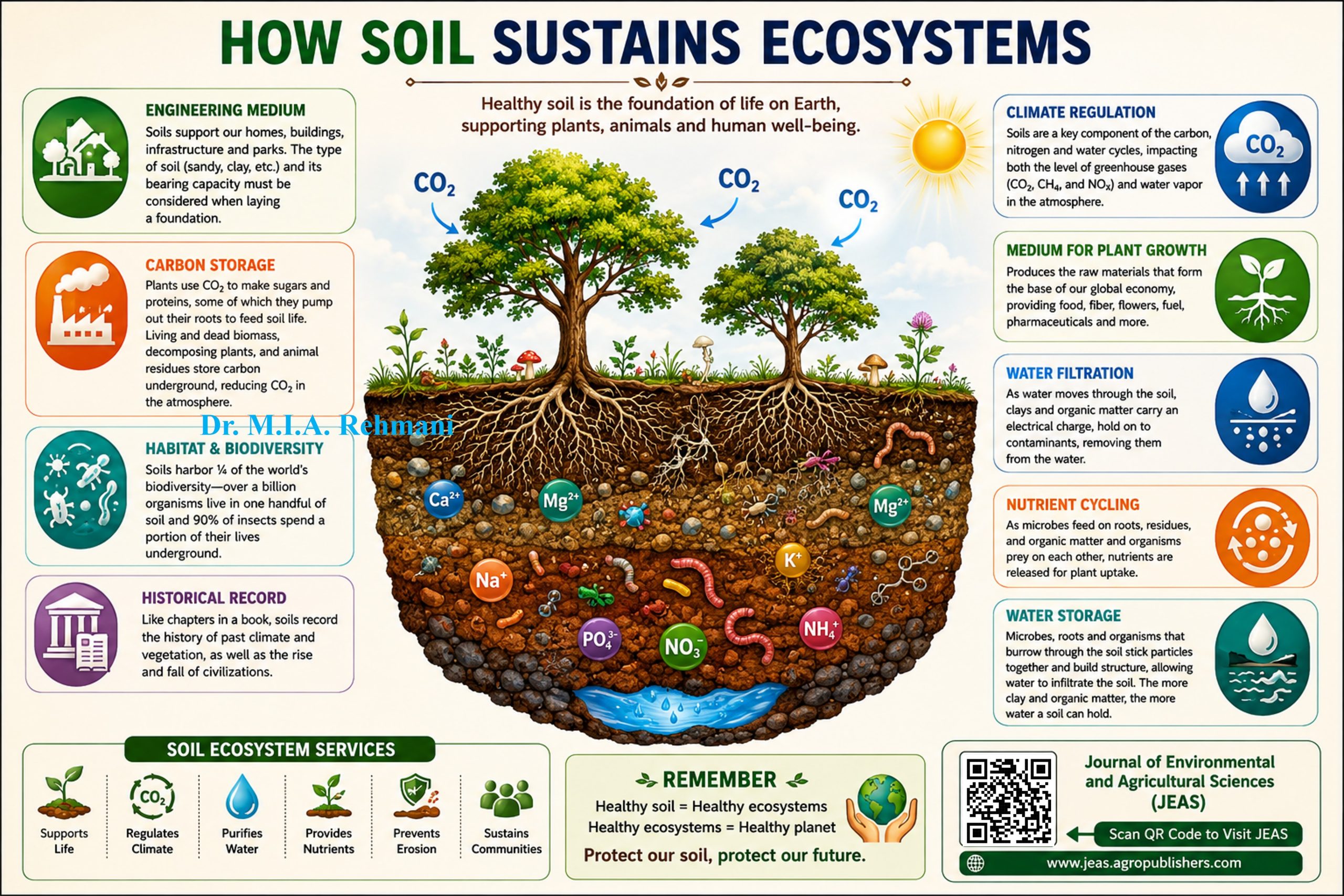
Soil provides plants with physical support, water, oxygen and essential macronutrients (nitrogen (N), phosphorus (P), potassium (K), calcium (Ca), and magnesium (Mg)) and also micronutrients. Agriculture, forests, and grasslands are essential to terrestrial food webs and play a foundational role in global food security, depends primarily on healthy soils.
[Plant Nutrition MCQs] [Soil Health MCQs]
3. Soil as a Climate Regulator
The soils are one of the world’s largest carbon reservoirs, containing more carbon than the atmosphere and vegetation. Soils sequester carbon dioxide (CO₂) from the atmosphere as a result of organic matter buildup and thus can contribute to climate change mitigation. Sustainable soil management helps to sequester more carbon and reduce greenhouse gas emissions (GHGs).
[Crop and Environment MCQs] [Climate Change MCQs] [Environmental Science MCQs]
4. Soils as a Water Purifier
Clay, organic matter, and soil microbes absorb or retain pollutants, pathogens and excess nutrients as the rainwater infiltrates through the soil. This natural filtration process recharges groundwater and improves groundwater quality for the benefit of ecosystems and humans.
5. Soil as a Nutrient Recycler
Plant residues and animal wastes are continually decomposed by microorganisms living in the soil, releasing plant-available nutrients. This nutrient cycling helps to maintain soil fertility, minimize waste accumulation, and promote sustainable agricultural production.
[Soil Health MCQs] [Plant Nutrition MCQs]
6. Soil as a Water Storehouse
Healthy soils can absorb and store rainwater as a natural reservoir. Organic matter incorporation in soil improves water-holding capacity and infiltration, subsequently reducing runoff and improving the soil structure. This function contributes to the drought resistance and resilience of crops and to reducing flood risk, while enhancing watershed resilience.
[Structure and Components of Watershed] [Major Threats to Watershed Health] [Soil Health MCQs]
7. Soil Supports Biodiversity
Soil contains almost a quarter of the biodiversity of Earth. Decomposition, nutrient cycling, disease suppression and soil formation are the main ecological services provided by a large number of soil-inhabiting organisms. A key priority to protect soil biodiversity is to ensure healthy ecosystems and resilient agriculture.
[Explore all MCQs] [Soil Health MCQs] [Soil Organic Matter MCQs]
8. Good Soil Prevents Erosion and Land Degradation
Plant roots adhere soil particles together, and decrease soil erosion due to wind and water. Adequately managed soils preserve the top fertile soil, soil productivity, and reduce soil pollution of adjacent rivers and lakes.
[Soil Health MCQs] [Environmental Science MCQs] [Soil Physical Properties MCQs]
9. Soil Preserves Environmental History
Soils are vital for archeological point of view, as they store signatures of past climate, vegetation and human activities. Soil layers are studied to trace environmental changes, to gain knowledge of the evolution of the ecosystem and to devise conservation strategies for the future.
[Soil Health MCQs] [Environmental Science MCQs]
Why Soil Conservation Matters
Despite the great importance of soil conservation, soil is under increasing pressure from erosion, deforestation, pollution, salinization, tillage-intensive agriculture, urbanization and climate change. Annually, millions of hectares of fertile and productive land are degraded worldwide, threatening food security, biodiversity and ecosystem services.
Conservation Agriculture
Conservation agriculture, crop rotation, cover cropping, agroforestry, organic matter management, reduced tillage, efficient irrigation and integrated nutrient management are sustainable practices that can help conserve soil. All of these strategies promote soil health and increase agricultural productivity and environmental sustainability.
[Soil Health MCQs] [Conservation Agriculture]
Healthy soil is the basis of healthy ecosystems. It supports plant growth, helps to keep the climate in check, filters and stores water, cycles nutrients, supports biodiversity and underpins global food production. Soil protection, thus, is not just an agricultural need but also an environmental need. Today’s investment in sustainable soil management ensures the resilience of ecosystems, food security and the health of future generations.
How Soil Sustains Ecosystems, why soil is important for ecosystems, soil health and ecosystem sustainability, role of soil in climate regulation, how healthy soil supports biodiversity, Why is soil important for life on Earth?
_______________________________________________________
Frequently Asked Questions (FAQs) about Soil and its Function
What is Carbon Sequestration?
Carbon sequestration refers to the phenomenon of capturing carbon dioxide (CO₂) from the atmosphere and storing it in soils, vegetation, and other natural systems, thus contributing to climate change mitigation.
What is Climate Regulation?
The regulation of the climate by soils through a combination of processes that soils undergo that affect the Earth’s climate by storing carbon, cycling greenhouse gases, and regulating water and energy exchange.
What is Conservation Agriculture?
Conservation agriculture is a sustainable farming system with minimal soil disturbance, permanent soil cover and crop diversification for soil health and productivity.
What are Ecosystem Services?
The ecosystem services are the benefits provided to humans from the ecosystem, such as food production, climate regulation, water purification, nutrient cycling, biodiversity conservation and cultural values.
What is an Ecosystem?
An ecosystem is a dynamic community of organisms that live and interact with one another and with their physical environment, functioning together as a single ecological unit.
What is Food Security?
Food security is achieved when all people have access to adequate, reliable and safe food at all times, while healthy soils form the basis for the sustainable production of food.
What is Groundwater Recharge?
It is the process by which rainwater is filtered through soil and replenishes the underground aquifer.
What is Land Degradation?
Land degradation is the decline or loss in land quality due to physical, chemical, or biological changes, reducing the land productivity and function.
What is Nutrient Cycling?
Nutrient cycling refers to the continuous process of transforming nutrients in the soil, plants, microorganisms, animals and atmosphere through biochemical processes.
What is Rhizosphere?
The rhizosphere is the small area of soil around plant roots where intense interactions between the roots, microorganisms, nutrients, and soil particles take place.
What is Soil Biodiversity?
Soil biodiversity is the variety of organisms inhabiting the soil, such as microorganisms, fungi, insects, earthworms and other soil fauna that play a role in the functioning of the ecosystem.
What is Soil Conservation?
Soil conservation is the protection and management of soil resources to ensure long-term productivity, prevent erosion, nutrient loss, nutrient depletion and loss of soil biodiversity.
What is Soil ecosystem?
A soil ecosystem is the complex network of soil organisms and their interactions with minerals, organic matter, water, and air that drive nutrient cycling, decomposition, and other ecosystem processes.
What is Soil Erosion?
Soil erosion is the detachment and transport of soil particles, leading to loss of top soil due to wind, water action or human activities and its transportation away.
What is Soil Fauna?
Animals that inhabit the soil, including earthworms, nematodes, mites, ants and insects, which enhance soil structure and promote decomposition, are known as soil fauna.
What is Soil Fertility?
Soil fertility is the capacity of the soil to provide the plant with the necessary nutrients, water and physical environment for proper plant development.
What is Soil Health
Soil health is the ability of a soil to function as a living ecosystem that provides plants, animals and humans with the resources they need while preventing degradation of the environment.
What is Soil?
Soil is the biologically active upper layer of the Earth’s surface composed of minerals, organic matter, water, air, and living organisms that support plant growth and perform essential ecosystem functions.
How Soil Sustains Ecosystems, why soil is important for ecosystems, soil health and ecosystem sustainability, role of soil in climate regulation, how healthy soil supports biodiversity, Why is soil important for life on Earth?
What are Soil Microorganisms?
They are tiny organisms not visible with the naked eye, such as bacteria, fungi, algae, archaea and protozoa, which break down organic matter, make nutrients available for plants, and promote plant growth.
What is Soil Organic Matter (SOM)?
It is the Organic matter present in soils, composed of humus, decomposing plant and animal matter, and living organisms that enhance soil fertility, structure and water holding capacity.
What is Soil resilience?
It is the capacity of soil to resist, recover from, and remain resilient to disturbance, including drought, flooding, erosion, pollution, and climate change, without compromising its functions.
What is Soil Structure?
It is the pattern in which soil particles are arranged to form aggregates, thereby influencing water infiltration, aeration, root penetration, and resistance to erosion.
How Soil Sustains Ecosystems, why soil is important for ecosystems, soil health and ecosystem sustainability, role of soil in climate regulation, how healthy soil supports biodiversity, Why is soil important for life on Earth?