
General Structure and Components of a Watershed
A watershed is a geographically defined land area that “sheds” or drains water (of all precipitation and surface runoff) into a specific waterbody. Every waterbody has a watershed, which drains rainfall and snowmelt into streams and rivers. These smaller waterbodies channel water flow into larger ones, including lakes, bays, and oceans.
It is important to note that not all rain or snow that falls on a watershed necessarily flows out in this way. Some seeps into the ground through infiltration, reaching into the aquifers, which are underground water reservoirs. However, some of the water ends up on hardpans or hard surfaces generally developed as roads and parking lots, from which water may enter storm drains that feed into streams.
Related Topics
Watershed Dynamics: Structure, Functions, and Ecological Importance
Major Threats to Watershed Health
What are the key components of a watershed?
Watershed (Drainage Basin): A geographically defined area where all precipitation drains to a single outlet (river, lake, ocean).
- Watershed Divide: A topographic boundary (ridgelines or high terrain) separating adjacent watersheds. Water on each side flows into different systems. It is the highest elevation point separating neighboring watersheds.
- Slopes are Inclined land surfaces that channelize water downhill through runoff and shallow subsurface flow.
- Headwaters or source zone: These are sources or origins of the streams, generally found as springs, melting snow, or small seeps in the highest elevations of the watershed. These are usually located at the uppermost part, often in small streams.
- Watershed Outlet or Common Outlet is the final discharge point where water from the watershed exits into a larger water body. It is the downstream point where all collected water exits, key for monitoring hydrology and water quality. It is the single point where all water within the watershed gathers and exits, such as a river mouth or reservoir.
- Stream Network, including Tributaries, Main Channel (or Trunk Stream), Perennial, Intermittent, and Ephemeral streams.
Tributaries: Smaller streams and creeks that flow into larger ones
Main Channel / Trunk Stream: The primary watercourse that collects water from all tributaries
Perennial, Intermittent, and Ephemeral streams: Based on whether they flow year-round, seasonally, or only after rain - Interfluves are elevated land areas between adjacent stream valleys or drainage channels.
- Channels are natural pathways (streams and rivers) that transport water, sediments, nutrients, and organic matter through the watershed.
- Floodplains are relatively flat lowland areas adjacent to rivers that serve as a water reservoir (temporarily store excess water) during flooding events and often contain fertile soils through sedimentation.
- Riparian Zones are vegetated transitional areas along rivers, streams, and wetlands that stabilize banks, filter pollutants, reduce erosion, and provide wildlife habitat.
- Runoff or surface runoff is water flowing over the land surface when rainfall exceeds the soil’s infiltration capacity. Water moving over land or soil surface, after rainfall exceeds infiltration capacity. Primary transporter of sediment, nutrients, and pollutants.
- Infiltration is the process through which water enters the soil surface and moves into soil pores.
- Streamflow is the movement of water within streams and rivers toward downstream outlets.
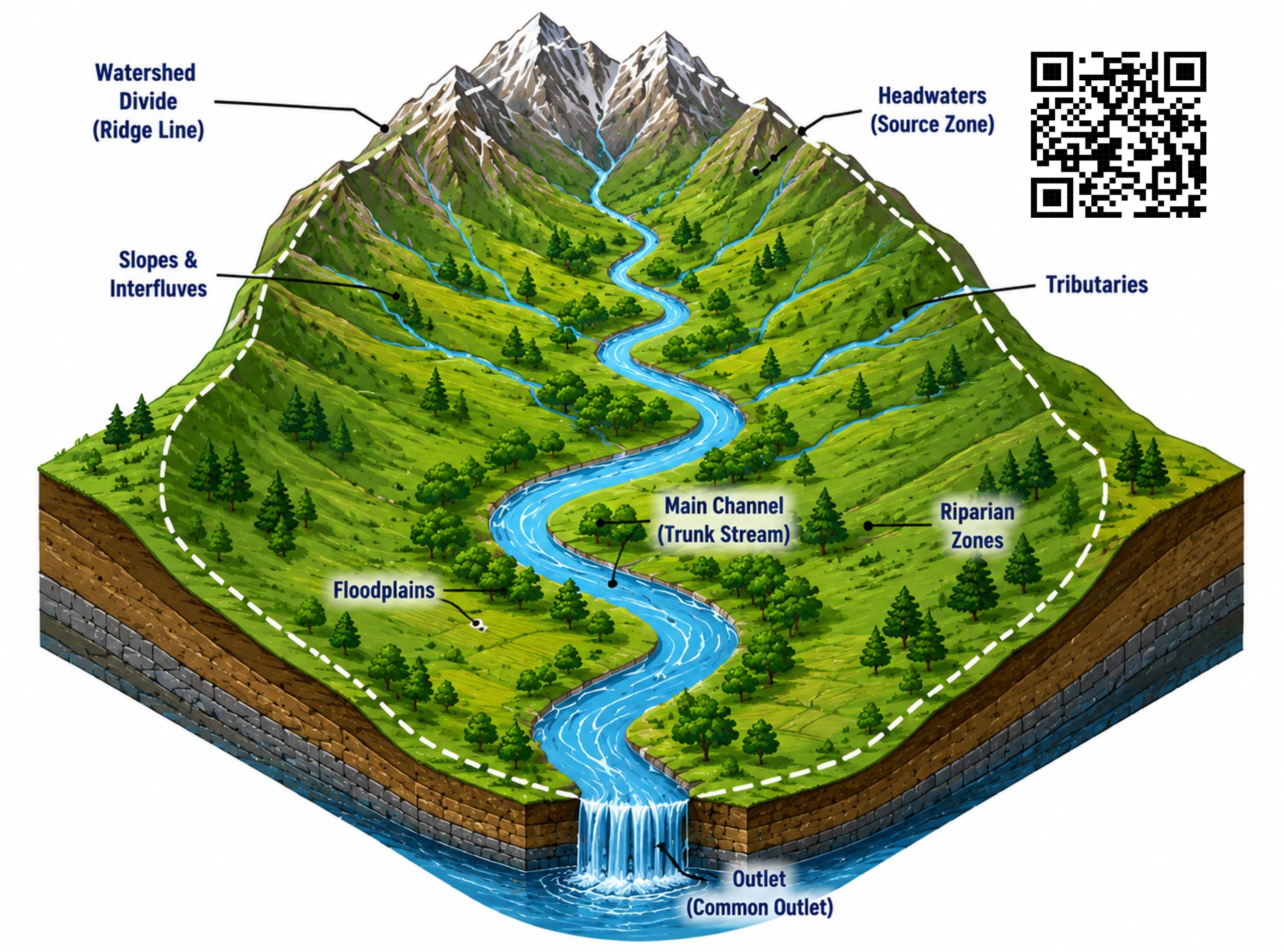
Key components of a Watershed
Stream Order is a hierarchical classification of stream size and branching. Small headwaters (low order) merge into larger channels (higher order), controlling flow and sediment transport.
Biodiversity is the variety of living organisms, including plants, animals, fungi, and microorganisms, within an ecosystem.
Ecosystem Services are benefits provided by ecosystems to humans, including water purification, flood regulation, soil conservation, food production, and climate regulation.
Sediments are soil particles, rock fragments, and organic materials transported by flowing water, which generally settle down in the floodplains.
Nutrients are essential chemical elements such as nitrogen (N), phosphorus (P), and potassium (K) that support plant and microbial growth. Nutrients generally suspected in the water, attached to soil particles.
Hydrology is the scientific study of water movement, distribution, storage, and interactions within the Earth system.
Watershed Management is the integrated management of land, water, vegetation, and human activities within a watershed to maintain environmental quality and resource sustainability.
Water Resources are natural sources of water, including rivers, lakes, groundwater, wetlands, glaciers, and reservoirs used for ecological and human needs.
Soil–Water Interactions is the physical, chemical, and biological processes governing the movement and storage of water within soils and its effects on soil properties and plant growth.
Integrated Water Management is a coordinated approach to managing water, land, and related resources for maximizing social, economic, and ecological sustainability.
The hydrological cycle is the processes including precipitation, runoff, infiltration, and groundwater flow.
General structure and components of a watershed, Watershed structure and components explained, Watershed dynamics and water cycle processes, Watershed structure and hydrological processes, Surface runoff and infiltration in watersheds.
What causes water movement in a watershed?
A combination of energy inputs (primarily gravity and solar energy) and physical forces (pressure, friction, and capillary action) guides the path that water takes across the landscape. Here are the specific causes, broken down by where and how the water moves.
Gravity is the most important driver of downward and downstream water movement
Solar Energy is the Pump that causes evaporation (liquid water turning into water vapor) and drives transpiration (plants pulling water from roots to leaves) through heat.
General structure and components of a watershed, Watershed structure and components explained, Watershed dynamics and water cycle processes, Watershed structure and hydrological processes, Surface runoff and infiltration in watersheds.
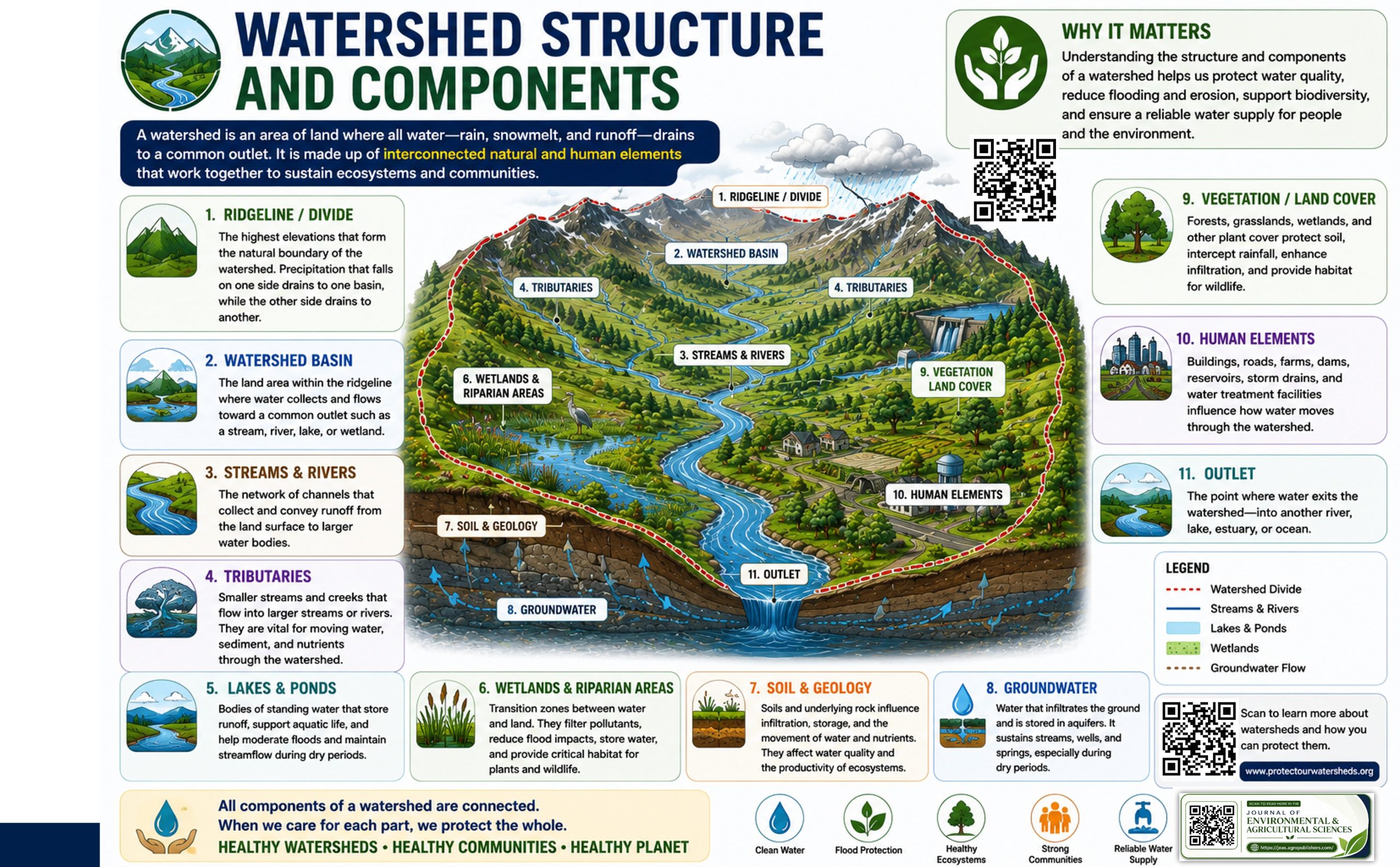
General structure and components of a watershed, Watershed structure and components explained, Watershed dynamics and water cycle processes, Watershed structure and hydrological processes, Surface runoff and infiltration in watersheds.
What is the General Structure and Components of a watershed?