Green Water: The Hidden Driver of Crop Growth and Nutrient Uptake
Green water is crucial for rainfed farming. It provides a balanced mix of minerals, organic matter, roots, and organisms, enhancing #SoilHealth and ecosystem vitality.
Water is often discussed in terms of irrigation, canals, rainfall, rivers, and groundwater reserves. However, green water is a less visible but critically important component of agricultural water systems. Green water supports crop growth, biomass production, and nutrient uptake through interactions among soil, plant roots, microorganisms, and ecological processes.
Green water represents the portion of rainwater stored in the soil and used directly by plants through root uptake and transpiration. Unlike “blue water” (surface and groundwater), green water remains within the soil-plant-atmosphere continuum and forms the foundation of rainfed agriculture.
What is green water?
Green water is: Soil moisture derived from rainfall; Water stored within the unsaturated soil zone; Water available for plant uptake and evapotranspiration.
How is Green Water different from Blue Water?
It differs from blue water because it does not accumulate in rivers, lakes, or aquifers. Instead, it sustains crops directly through the root zone.
Nearly 60–70% of global food production depends on green water resources.
How Green Water Facilitates Nutrient Uptake?
It facilitates the dissolution of nutrients
Most plant nutrients must dissolve in soil water before roots can absorb them. Green water acts as the transport medium, converting nutrients into plant-available ionic forms.
Nitrate (NO₃⁻), Potassium (K⁺), Calcium (Ca²⁺), Phosphate ions (H₂PO₄⁻)
Without adequate soil moisture, nutrient diffusion slows dramatically.
Biomass accumulation depends directly on photosynthesis, which requires: Water, Nutrients, Carbon dioxide, and solar radiation
Green water supports biomass production by
Maintaining leaf turgor; Regulating stomatal conductance; Enabling nutrient translocation; Supporting chlorophyll synthesis
Deficiency of green water harms the following:
- Leaf area development
- Photosynthetic rate
- Dry matter accumulation
- Grain filling
How can changing climatic conditions influence the availability of green water?
Climate change threatens green water availability through:
- Erratic rainfall leading to uncertainty in water availability
- Higher temperatures can increase evapotranspiration, leading to reduced availability of green water
- Soil degradation can reduce water storage capacity of soil
- Intensity, duration and frequency of drought events can hamper availability of green water
Maintaining green water storage is becoming essential for climate-resilient agriculture.
What are the strategies to improve green water in soil?
Strategies listed below can help improve green water status
- Conservation tillage
- Mulching
- Cover cropping
- Agroforestry
- Organic matter management
- Rainwater harvesting
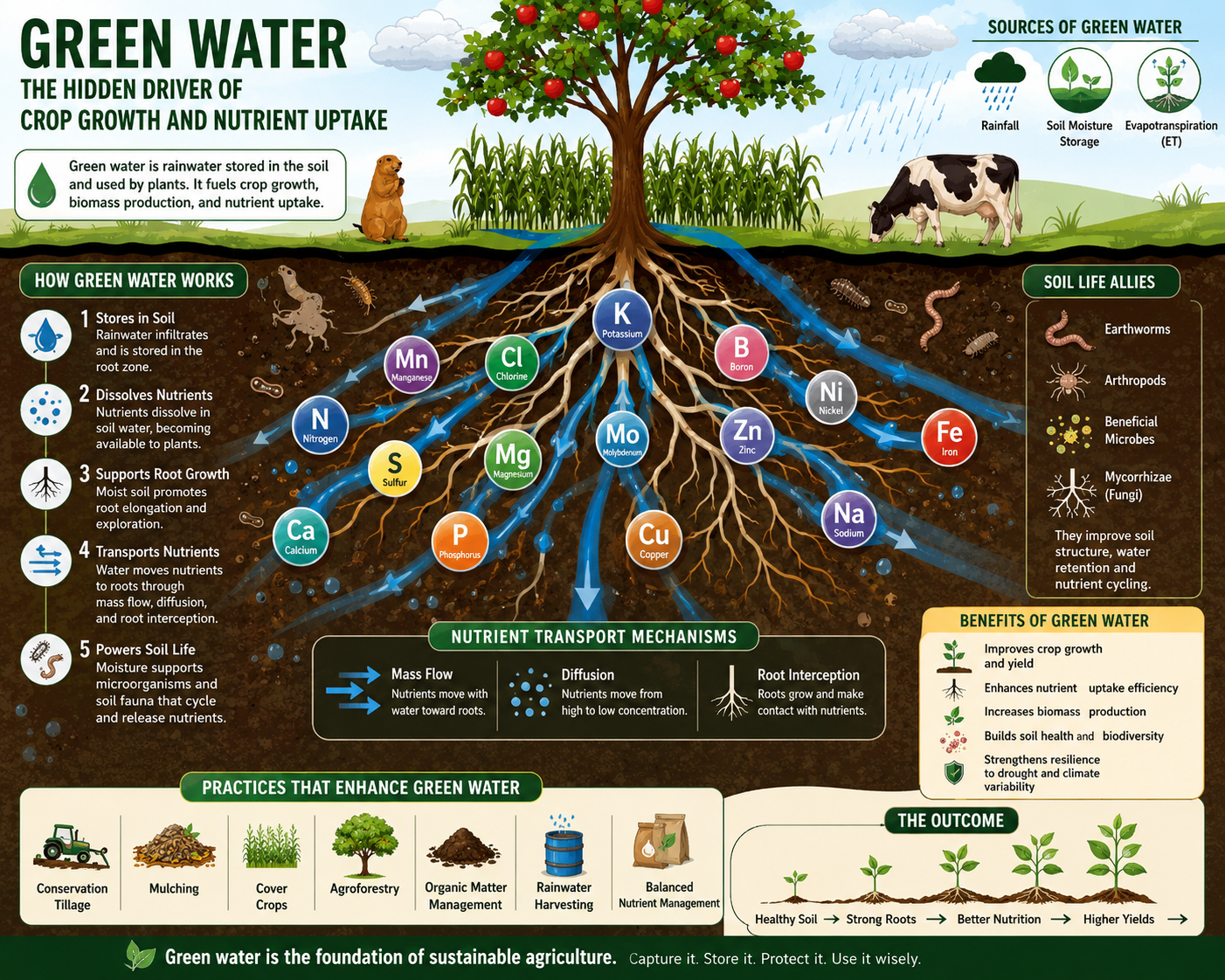
Green Water: The Hidden Driver of Crop Growth and Nutrient Uptake, Green water and nutrient uptake in crops, Role of green water in sustainable agriculture, How green water supports crop growth, Green water management for higher crop yields, Soil moisture and plant nutrient absorption, Importance of green water in rainfed agriculture, Green water productivity in agricultural systems
Green Water: The Hidden Driver of Crop Growth and Nutrient Uptake, Green water and nutrient uptake in crops, Role of green water in sustainable agriculture, How green water supports crop growth,
#GreenWater #SustainableAgriculture #SoilHealth #CropNutrition #PlantScience #ClimateSmartAgriculture #Agroecology #NutrientUptake #SoilScience #WaterManagement
