
Major Threats to Watershed Health
Watersheds are among the most important ecological and hydrological systems on Earth. Watersheds collect, store, filter, and distribute water while supporting biodiversity, agriculture, climate regulation, and human livelihoods. Healthy watersheds regulate streamflow, recharge groundwater, maintain soil fertility, and sustain aquatic ecosystems. However, increasing anthropogenic stresses and climatic anomalies are rapidly threatening and degrading watershed integrity across the globe.
Related Topics
Watershed Dynamics: Structure, Functions, and Ecological Importance
General Structure and Components of a Watershed
Related Articles in JEAS
-
Green Water: The Hidden Driver of Crop Growth and Nutrient Uptake
-
Ali, A. 2021. Assessment of Groundwater Quality using Geographical Information System: A Case Study of Faisalabad, Pakistan. Journal of Environmental & Agricultural Sciences. 23(1&2): 30-35. [View Full-Text]
- Ali, A., H.U. Farid and M.M.H. Khan. 2020. Divergent effect of rainfall, temperature and surface water bodies on groundwater quality in Haveli Canal Circle of Multan Irrigation Zone, Southern Punjab, Pakistan. Journal of Environmental and Agricultural Sciences. 22(4): 25-36. [Abstract] [View Full-Text]
- Nkurunziza, I.F., T. Guirong, J.P. Ngarukiyimana and C. Sindikubwabo. 2019. Influence of the Mascarene High on October-December rainfall and their associated atmospheric circulation anomalies over Rwanda. Journal of Environmental & Agricultural Sciences. 20:1-20. [Abstract]
- Wakachala, F.M., Z.W. Shilenje, J. Nguyo, S. Shaka and W. Apondo. 2015. Statistical Patterns of Rainfall Variability in the Great Rift Valley of Kenya. Journal of Environmental & Agricultural Sciences. 5:17-26. [View Full-Text][Citations]
- Parak et al., 2015. Trends and anomalies in daily climate extremes over Iran during 1961– 2010. Journal of Environmental & Agricultural Sciences. 2:11. [View Full-Text]
- Basheer, A.K., A.B. Ali, N. A. Elshaikh and G.H. Agbna. 2023. Sustainable utilization of water resources in the agriculture sector of Sudan, after the secession of South Sudan. Journal of Environmental & Agricultural Sciences. 25(1&2): 51-66. [Abstract] [View Full-Text] [Citations]
The major threats to watershed health can broadly be grouped into four interconnected categories: climate change, land-use changes, pollution, and physical alterations to waterways. These pressures disrupt hydrological processes, reduce ecosystem resilience, and compromise water security for both natural and human systems.
The major threats to watershed health can be categorized into four primary groups
1. Climate change
2. Land-use changes (including urbanization and agriculture)
3. Pollution
4. Physical alterations to waterways
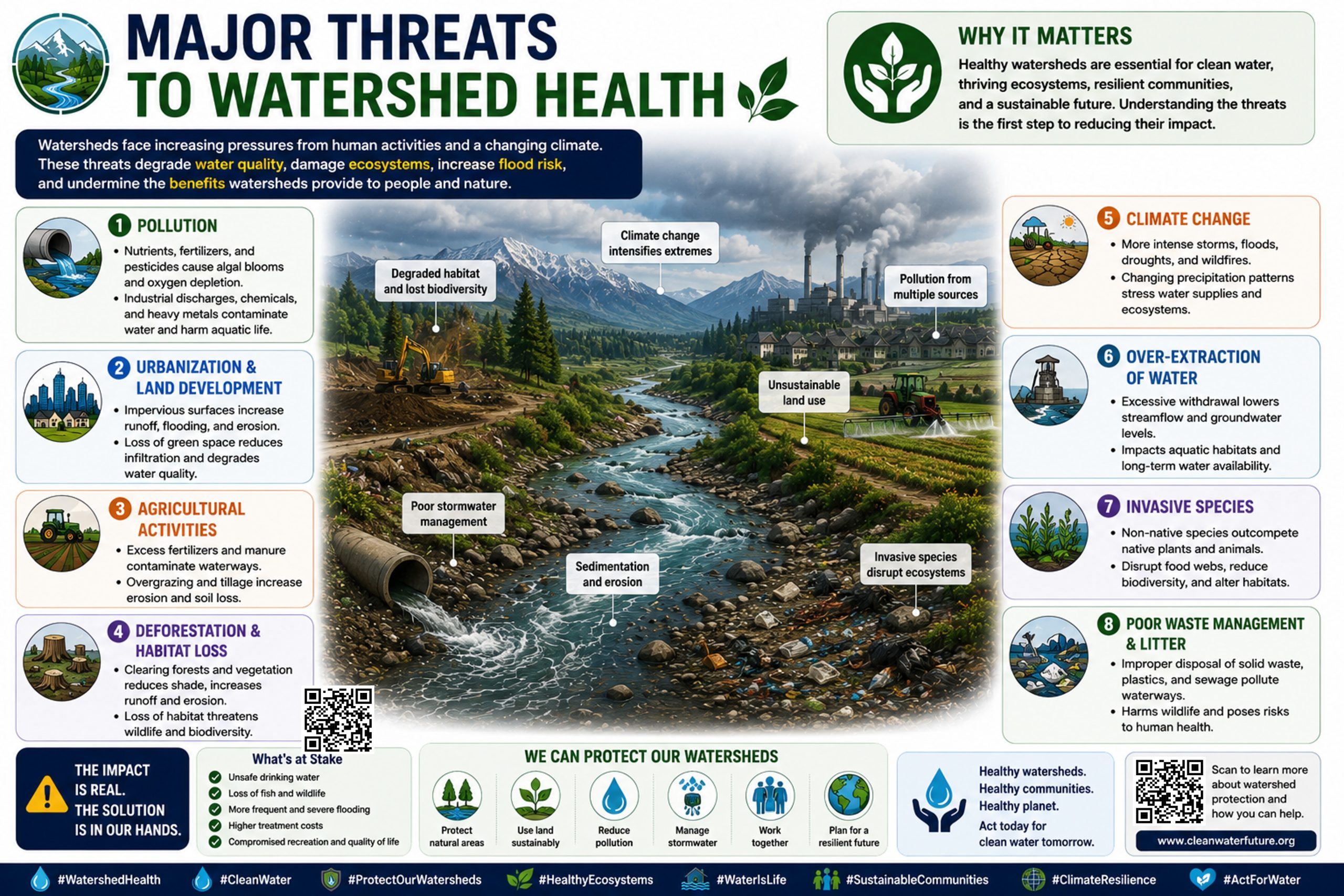
Major Threats to Watershed Health, Physical alterations to watershed systems, climate change impacts on watershed ecosystems, land use changes and watershed degradation, watershed degradation under climate change, impacts of urbanization on watersheds, agricultural runoff and watershed pollution, watershed health and ecological connectivity
1. Climate Change
Climate change is one of the most critical and rapidly intensifying threats to watershed systems. Anomalies in temperature, precipitation patterns, and extreme weather events are affecting watershed hydrology and ecosystem functioning.
1.1. Anomalies in Precipitation Patterns: Many regions across the globe are experiencing changes in intensity, frequency and distribution of precipitation, causing prolonged droughts, cloud bursts, and extreme rainfall events. Heavy rainfall increases surface runoff, soil erosion, and sediment transport, while drought reduces streamflow and groundwater recharge.
1.2. Glacier Retreat and Snowmelt Changes: Mountain watersheds dependent on glaciers and seasonal snowpacks are especially vulnerable. Rising temperatures accelerate glacier melting and alter timing of snowmelt, disrupting downstream water availability and irrigation systems.
1.3. Increased Floods and Droughts: Climate variability intensifies hydrological extremes. Flood events damage infrastructure, degrade soils, and transport pollutants into rivers, whereas droughts restrict water storage and aquatic habitat quality, and also influence the structure and composition of biodiversity in the region.
1.4. Ecosystem Stress: Rising temperatures affect aquatic biodiversity by reducing dissolved oxygen levels and increasing thermal stress in streams and rivers. Sensitive species may decline or disappear entirely.
2. Land-Use Changes
Anthropogenic landscape modifications significantly alter watershed structure and hydrological functioning. Urbanization, deforestation, and agricultural intensification are among the key drivers of watershed degradation.
2.1. Urbanization
Road expansion, construction of concrete buildings, and paved surfaces are leading to impermeable surfaces, which reduce water infiltration and increase impervious cover. Consequently, less absorption of rainfall, and rapid runoff rather than infiltration into the soil. Major consequences of urbanization include increased frequency, intensity, intesity and duration of floods and peak discharge; limited infiltration and reduced groundwater recharge; water pollution; erosion of soil and streambanks, and habitat fragmentation and biodiversity loss.
2.2. Agricultural Intensification
Unsustainable agricultural practices can accelerate soil degradation and nutrient loss. Agriculture intensification potentially leads to excessive fertilizer and pesticide application, Over-irrigation, removal of natural vegetation, intensive tillage and overgrazing
2.3. Deforestation and Vegetation Loss
Forest removal reduces canopy interception and root stabilization, increasing runoff and erosion. Riparian vegetation loss also weakens natural filtration systems. Deforestation in different parts of the world is causing reduced infiltration, increased sediment transport, declining biodiversity, higher risks of landslides and changes in streamflow patterns.
3. POLLUTION
Pollution is a major driver of watershed degradation and directly affects water quality, ecosystem health, and human well-being.
3.1. Agricultural Pollution
Excessive application of nitrogen and phosphorus fertilizers enters rivers and lakes through runoff, causing eutrophication, whcih stimulate excessive algal growth. Eutrophication can have serious ecological implications, including oxygen depletion in water bodies, increased fish mortality, harmful algal blooms and reduced aquatic biodiversity. Moreover, pesticides and herbicides may also contaminate groundwater and aquatic ecosystems.
3.2. Industrial Pollution
Industrial discharges introduce toxic substances like heavy metals, hydrocarbons, and chemical contaminants into watershed systems. Common pollutants include Lead (Pb), Mercury (Hg), Cadmium (Cd), industrial solvents, and petroleum products. These pollutants accumulate in sediments and aquatic food webs, posing risks to both ecosystems and human health.
3.3. Urban and Domestic Waste
Untreated sewage, plastics, and household waste enter the water bodies and degrade water quality and increase microbial contamination. Pathogen contamination, microplastic accumulation, organic pollution and reduced drinking water safety are among the major concerns related to waste pollution in watersheds and water bodies.
3.4. Atmospheric Pollution
Airborne pollutants dissolved in rainwater are deposited on the soil and water bodies. These depositions can lower soil pH and acidification of water bodies, modifying nutrient availability and balance and subsequently impede ecosystem processes.
4. PHYSICAL ALTERATIONS TO WATERWAYS
Physical alterations to rivers, streams, wetlands, and floodplains disrupt the hydrological cycle, natural watershed processes and ecological connectivity. Dam construction, channelization, sand mining and wetland drainage, are among the key physical alterations that modify water flow, water characteristics, sediment transport and trapping, groundwater recharge, and habitat fragmentation. These modifications increase erosion, reduce biodiversity, weaken flood regulation, and diminish the natural capacity of watersheds to maintain ecological balance and water quality.
Major Threats to Watershed Health, Physical alterations to watershed systems, climate change impacts on watershed ecosystems, land use changes and watershed degradation, watershed degradation under climate change, impacts of urbanization on watersheds, agricultural runoff and watershed pollution, watershed health and ecological connectivity
Related Topics
Watershed Dynamics: Structure, Functions, and Ecological Importance
General Structure and Components of a Watershed
Major Threats to Watershed Health, Physical alterations to watershed systems, climate change impacts on watershed ecosystems, land use changes and watershed degradation, watershed degradation under climate change, impacts of urbanization on watersheds, agricultural runoff and watershed pollution, watershed health and ecological connectivity
#EnvironmentalProtection #LandscapeEcology #FloodManagement #RiparianZones #IntegratedWaterManagement #HydrologicalCycle #GroundwaterRecharge
#CatchmentManagement #WaterSecurity #RiverEcology #FreshwaterEcosystems #WetlandConservation