
How Silicon Helps Plants Survive Drought
Water scarcity has become one of the greatest threats to global agricultural productivity. The unprecedented increase in the frequency, intensity, and duration of extreme weather events, rising temperatures, and uncertain, erratic rainfall is exposing crops to greater drought stress, making it essential to identify practical approaches to improve plant resilience. Among the key research areas receiving growing scientific attention is silicon (Si). Although most plant species do not require silicon as an essential nutrient, however, numerous studies have shown that it can substantially improve drought tolerance of crop plants.
Test Your Knowledge [Explore all MCQs]
[Fundamentals of Plant Nutrition MCQs] [Soil Science MCQs] [Climate Change MCQs]
[Environmental Science MCQs] [Plant Physiology MCQs] [Plant and Environment MCQs]
[Forestry, Range Management & Wildlife MCQs]
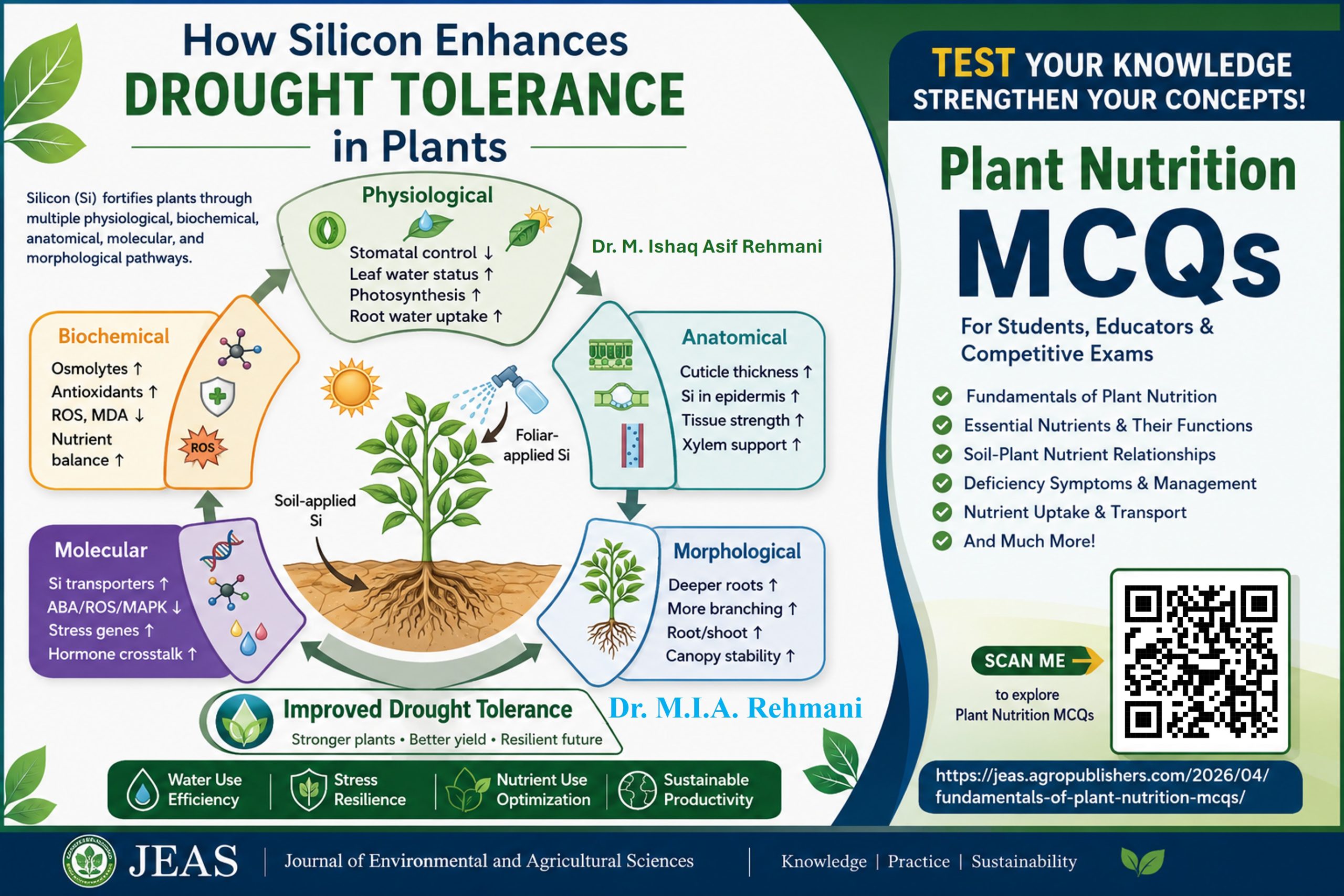
Silicon supports drought adaptation by influencing multiple processes involved in plant growth and metabolism. Improving plant processes from cellular to whole plant level, allowing crops to maintain better performance under water-deficit conditions.
Maintaining Normal Plant Functions
One of the earliest effects of drought is the disruption of normal physiological processes. Silicon helps plants maintain internal water levels by improving stomatal regulation, thereby reducing moisture loss. Plants supplemented with silicon maintain higher leaf water contents, enabling efficient photosynthesis, especially during water stress periods. Silicon also enhances root capacity to absorb available soil moisture, supporting continued growth even under water-scarce conditions.
Building Stronger Plant Structures
Silicon contributes to the physical reinforcement of plant tissues. After absorption, silicon creates a protective barrier that hinders excessive transpiration. Moreover, stronger cell walls and improved vascular tissues also improve plant structural stability and sustain water movement from the roots to the shoots, particularly during drought.
Encouraging Better Root Development
A healthy root system is essential for plant survival under stress conditions like drought. Silicon promotes deeper and more extensive root systems that can explore a larger soil volume for moisture extraction. Increased root branching and improved growth allow plants to access more water from larger soil area. A stronger root system also helps maintain balance between below-ground and above-ground growth, keeping plants vigorous under stress conditions.
Protecting Cells from Oxidative Damage
Drought stress triggers the formation of harmful reactive oxygen species (ROS), which can damage key biomolecules at the cellular level, like protective membranes, structural proteins, and nucleic acids. Silicon helps counteract this damage by stimulating the plant’s antioxidant defense system. Resultantly, activating the protective enzyme system consisting of superoxide dismutase (SOD), catalase (CAT), and peroxidases primarily reduces oxidative damage. Silicon also promotes the accumulation of osmoprotective compounds, including proline and soluble sugars, which help cells retain water and maintain membrane stability.
Regulating Stress-Responsive Genes
Silicon is also involved in genetic regulation of plant response to drought and other stresses. It modifies abscisic acid (ABA) associated signaling pathways and regulation of reactive oxygen species, and mitogen-activated protein kinases (MAPKs). These changes trigger upregulation of genes involved in stress protection and phytohormone signaling, leading to improved plant adaptation to drought conditions.
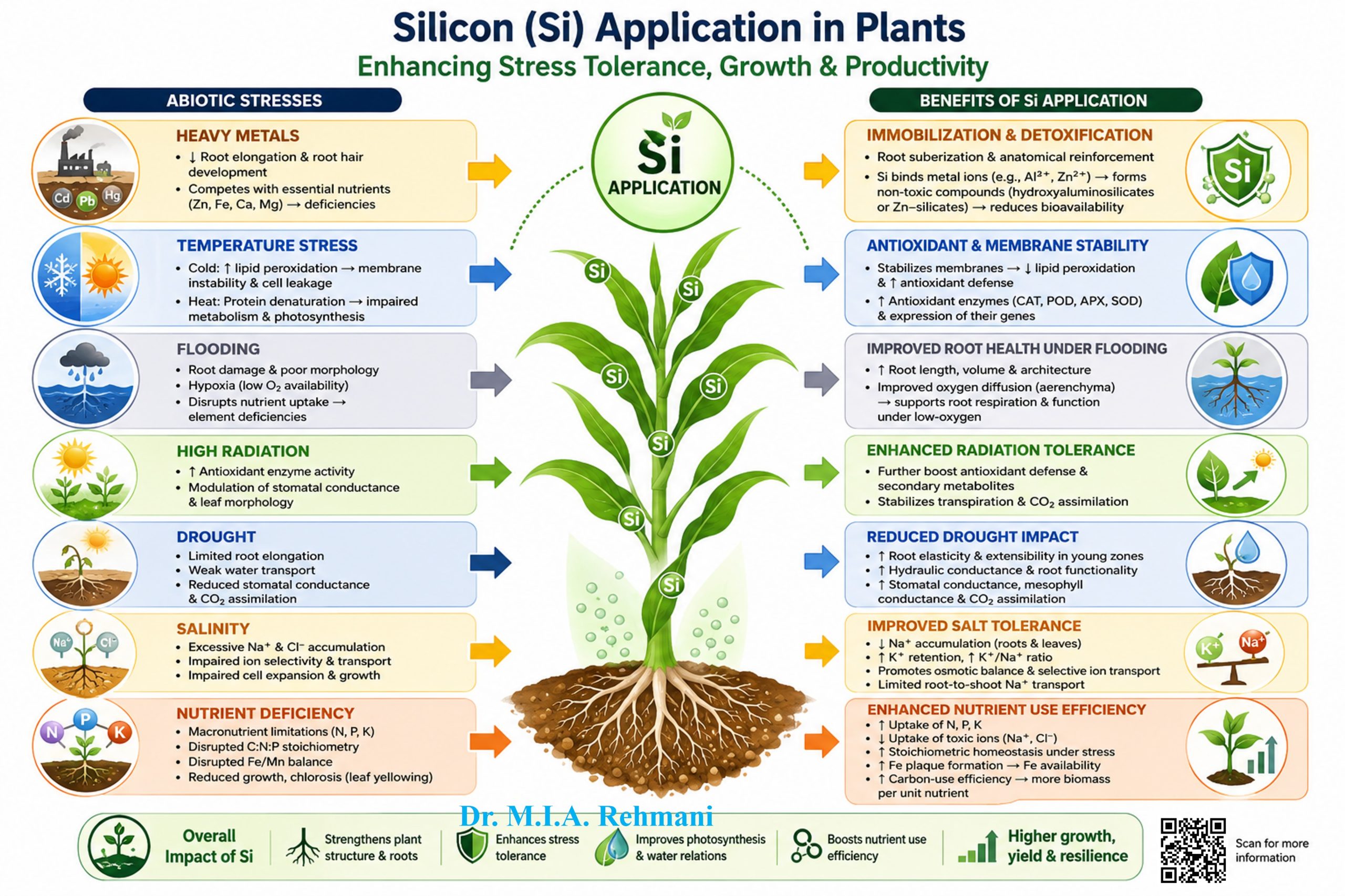
Silicon in Sustainable Crop Production
Silicon can be supplemented through soil or foliar applications, depending on plant, soil characteristics, and management practices. Cereal crops (e.g., rice, wheat, maize) and sugarcane often show strong responses to silicon application. Moreover, several vegetables, fruits, and ornamental plants also showed improved performance by the silicon supplementation under drought stress.
As the agricultural sector faces increasing pressure from climate change, silicon offers a practical and environmentally friendly option for enhancing crop resilience. By improving water conservation, reinforcing plant tissues, supporting root growth, strengthening antioxidant defenses, and regulating stress-related genes, silicon enables plants to cope more effectively with drought. Incorporating silicon into nutrient management programs, therefore, represents a promising strategy for improving productivity and sustainability in water-limited environments.
How Silicon Helps Plants Survive Drought, silicon application in plants, Root architecture under drought, Foliar silicon application, silicon-mediated drought tolerance
What is Silicon’s Role in Drought Tolerance of Plants?
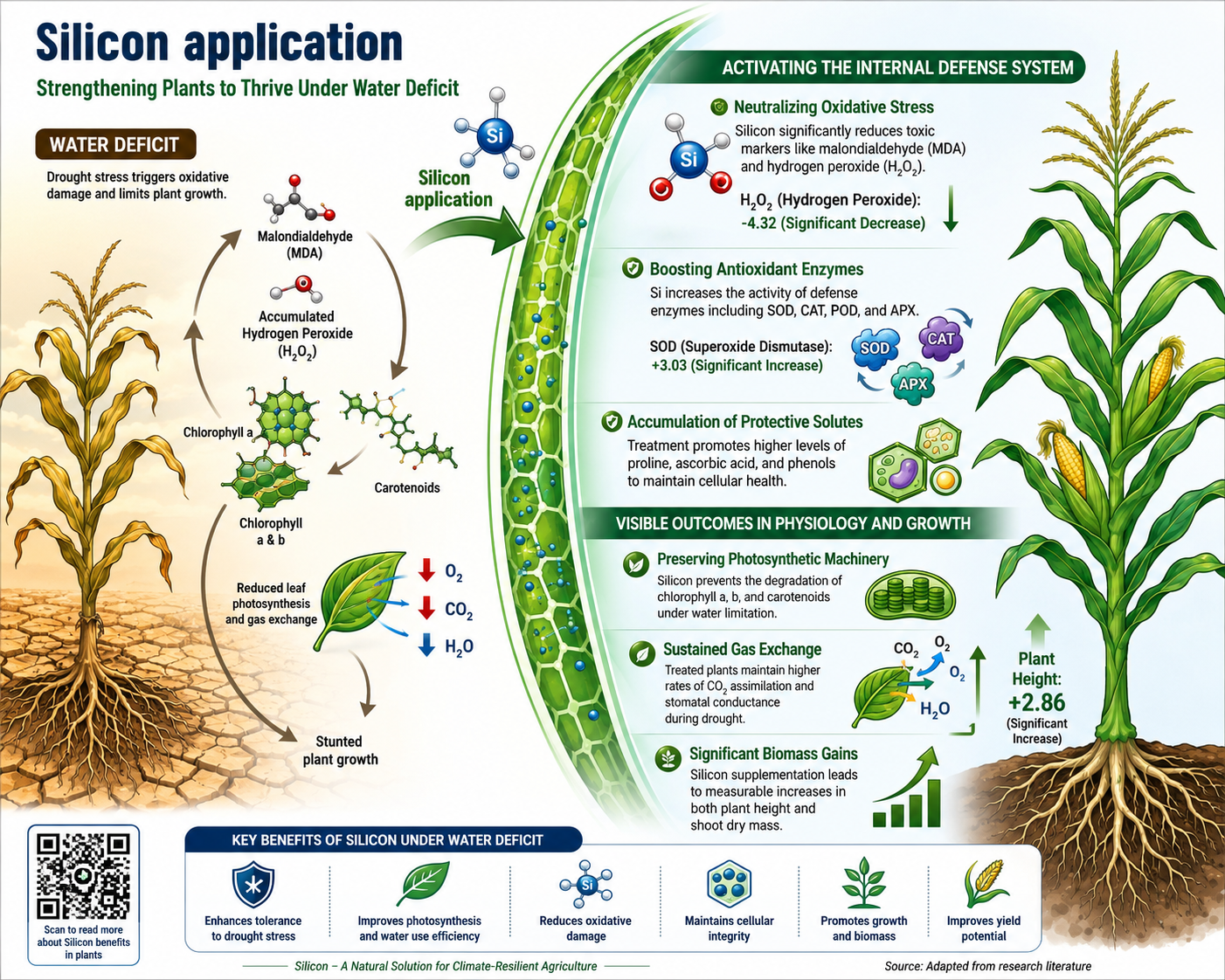
Silicon plays a vital role in enhancing plant tolerance to drought stress by strengthening multiple defense mechanisms at various levels (anatomical, biochemical, molecular and physiological). Although not considered an essential nutrient for most plant species,
Silicon is widely recognized as beneficial element because it enhances plant resilience under water-deficit conditions.
Silicon enhances root water uptake, maintains leaf water status, reduces transpiration, protects photosynthetic machinery, and stimulates antioxidant defense systems, enabling plants to maintain growth and productivity during drought.
Its ability to enhance water use efficiency and reduce oxidative damage makes silicon an important tool for climate-resilient and sustainable agriculture.
Is Silicon an Essential Plant Nutrient?
Considering classical criteria of essentiality (Arnon and Stout,1939), Silicon is not categorized as an essential plant nutrient. This is mainly because most plants can complete their life cycle without Silicon. However, due to its substantial positive effects on plant growth, productivity, and resistance to abiotic and biotic stresses, it is widely reported as a beneficial element.
Several agronomic and horticultural crops biologically accumulate large amounts of silicon. Silicon application shows substantial improvements in plant performance under abiotic (drought) and biotic (disease) stresses, leading to healthier crops, lodging resistance, and nutrient-use efficiency. Consequently, the application of silicon is rapidly increasing to ensure sustainable crop management, despite its non-essential status.
Test Your Knowledge [Explore all MCQs]
[Fundamentals of Plant Nutrition MCQs] [Soil Science MCQs] [Climate Change MCQs]
[Environmental Science MCQs] [Plant Physiology MCQs] [Plant and Environment MCQs]
[Forestry, Range Management & Wildlife MCQs]
____________________________________________
How Silicon Helps Plants Survive Drought, Root architecture under drought, Mechanisms of silicon-mediated drought tolerance, Silicon nutrition for sustainable crop production, Osmolytes in plants
How Silicon Helps Plants Survive Drought, silicon application in plants, Root architecture under drought, Foliar silicon application, silicon-mediated drought tolerance
Suggested Readings
Coskun, Devrim, et al. 2016. The role of silicon in higher plants under salinity and drought stress. Frontiers in plant science 7: 1072.
Ghadirnezhad Shiade, S.R., et al. 2026. Silicon at the Frontline: Enhancing Plant Multistress Tolerance. Journal of Soil Science and Plant Nutrition. 26: 3089–3111.
Mora-Sanhueza, Rodrigo, et al. 2025. Plant resilience to abiotic stresses: revealing the role of silicon in drought and metal (loid) tolerance. Journal of Experimental Botany 76.17: 4869-4883.
Ogedengbe, Olajumoke, et al. 2026. Silicon-mediated drought resilience mechanisms in crops: from physiology to molecular insights. Frontiers in Plant Science 17: 1788106.