
Microbiology MCQs (Microbiology Quiz Series)
Multiple Choice Questions for Professional Test Preparation
[Explore all MCQs] [Microbiology MCQs] [Plant Pathology MCQs]
[Mycology MCQs] [Enzymology MCQs] [Food Science MCQs]
[Biology MCQs][Botany MCQs] [Zoology MCQs]
| [MCQ Quiz 1] | [MCQ Quiz 2] | [MCQ Quiz 3] | [MCQ Quiz 4] |
| [MCQ Quiz 5] | [MCQ Quiz 6] | [MCQ Quiz 7] | [MCQ Quiz 8] |
| [MCQ Quiz 9] | [MCQ Quiz 10] | [MCQ Quiz 11] | [MCQ Quiz 12] |
| [MCQ Quiz 13] | [MCQ Quiz 14] | [MCQ Quiz 15] | [MCQ Quiz 16] |
| [MCQ Quiz 17] | [MCQ Quiz 18] | [MCQ Quiz 19] | [MCQ Quiz 20] |
_______________________________________________
Microbiology MCQs, Microbiology objective questions, Important Microbiology MCQs for Competitive Exams, Microbiology MCQ Quizzes, Microbiology Quiz Series
[Soil Science MCQs] [Plant Nutrition MCQs] [Crop and Environment MCQs] [Soil Physical Properties MCQs] [Soil Chemical Properties MCQs] [Soil Organic Matter MCQs][General Agriculture MCQs] [Agronomy MCQs] [Plant Physiology MCQs]
What are microbes?
Microbes or microorganisms are microscopic living organisms, too small to be seen with the naked eye. Microbes are highly adaptable and are found everywhere on Earth, including in water, soil, and the air. They also live on and inside the human body.
Microbes are generally harmless to humans, through many are even beneficial, e.g., bacteria in our gut help us digest food, and some are used to produce foods like yogurt and cheese. However, a small percentage (less than 1% of bacteria) can cause disease (pathogens).
The category is broad and polyphyletic — it spans multiple domains of life rather than one taxonomic group. Microbes include bacteria, archaea, fungi, protozoa, algae, and some microscopic parasites. Although viruses are often studied in microbiology, they are generally not considered living organisms because they cannot reproduce independently and require a host cell.
- Bacteria: prokaryotic, unicellular organisms lacking a membrane-bound nucleus.
- Archaea: prokaryotic organisms, often found in extreme environments, distinct from bacteria at the molecular level.
- Fungi (microscopic forms): yeasts and molds; multicellular fungi like mushrooms are usually excluded from “microbes”, even though mycology overlaps with microbiology.
- Protozoa: unicellular eukaryotic organisms, often motile and heterotrophic.
- Algae (microscopic forms): unicellular or simple multicellular photosynthetic eukaryotes (e.g., diatoms).
- Viruses: acellular infectious agents; often studied within microbiology, though their inclusion as “living” or as true microbes is debatable.
What is Autoclaving?
Autoclaving is a moist heat sterilization method that uses pressurized saturated steam at high temperature (generally at 121°C and 15 psi for 15–20 min), to destroy all microorganisms, including bacterial spores. It is the most reliable and commonly used method for sterilizing laboratory media, equipments, instruments, glassware, and biomedical or biohazardous waste due to its high effectiveness against all microorganisms, including resistant bacterial endospores.
What is Gram Staining?
Gram staining is a differential staining technique (developed by Hans Christian Gram) that classifies bacteria based on the structure of their cell walls, into Gram-positive and Gram-negative groups.
Gram-positive bacteria retain the crystal violet stain and appear purple.
Gram-negative bacteria lose the primary stain during decolorization and take up the counterstain, appearing pink or red.
Gram staining is one of the most widely used methods for the identification and diagnosis of bacterial infections.
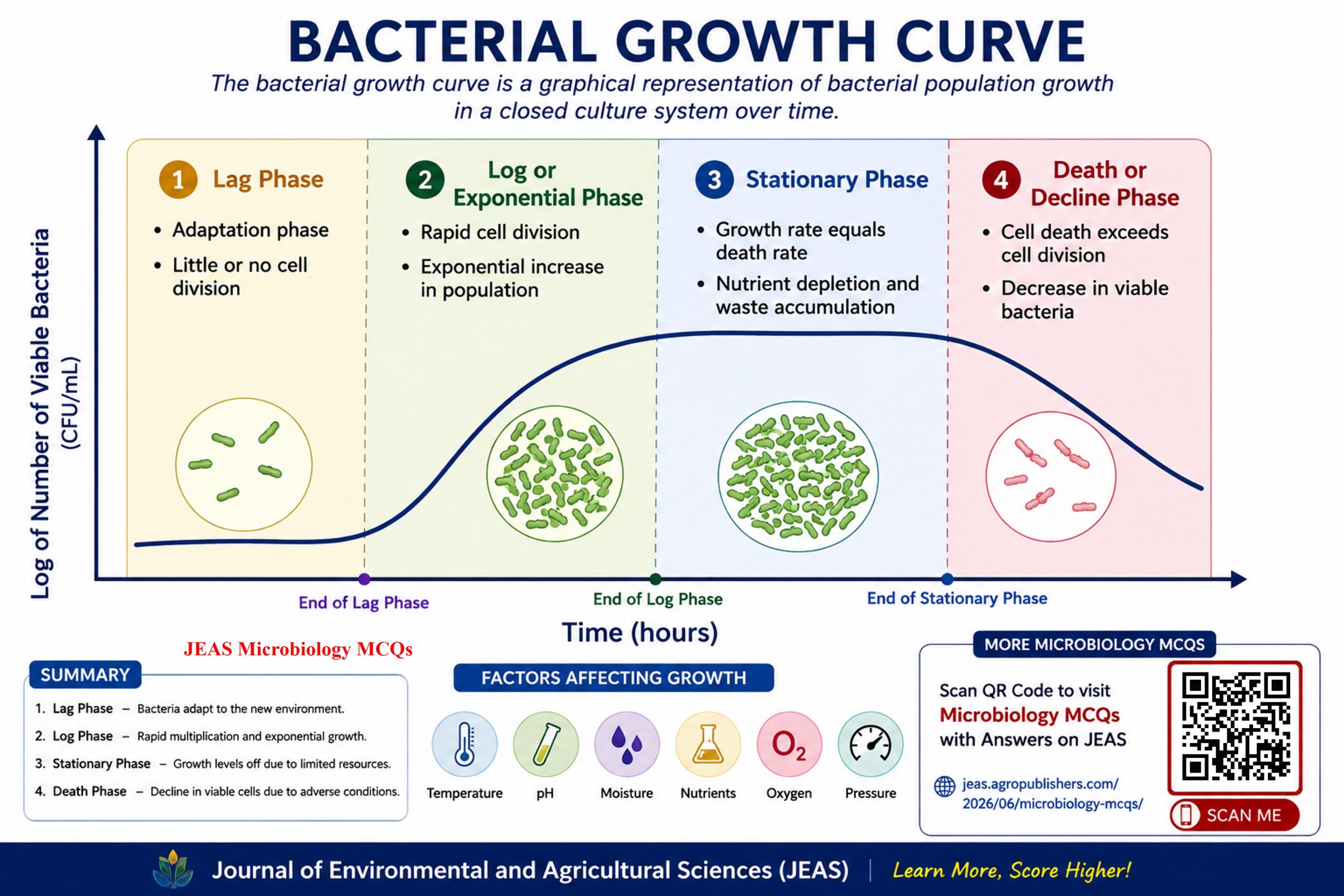
What is the Bacterial Growth Curve?
The bacterial growth curve is a graphical representation of bacterial population growth in a closed culture system over time.
The Bacterial Growth Curve have of four distinct phases:
lag phase (adaptation with little or no cell division),
log or exponential phase (rapid cell division and exponential growth),
stationary phase (growth rate equals death rate due to nutrient depletion and waste accumulation),
death or decline phase (cell death exceeds cell division, resulting in a decline in viable bacteria).
What is Mycology?
Mycology is the branch of biology that deals with the scientific study of fungi. including their classification, morphology, physiology, reproduction, ecology, and economic importance. It covers yeasts, molds, mushrooms, rusts, smuts, and other fungal organisms.
What are fungi?
Fungi are eukaryotic, heterotrophic organisms that obtain nutrients by absorption (heterotrophic) and produce spores for reproduction.
What are the main characteristics of fungi?
Fungal organisms lack chlorophyll (they cannot produce their food), possess chitinous cell walls, reproduce by spores, and obtain nutrients through absorption.
Why are fungi classified as heterotrophs?
As fungi are heterotrophs, they cannot produce their own food; therefore, for nutrition, they depend on organic matter from other organisms.
What is plasmogamy?
The word plasmogamy is derived from the Greek plasma (something molded or fluid substance/cytoplasm) and gamos (union). Biologically, it is the physical fusion of the cytoplasm (or protoplasm) of two separate parent cells or gametes. In fungi, plasmogamy is the fusion of cytoplasm from two compatible fungal cells.
What is karyogamy?
Karyogamy is derived from the words karyon (Greek for nut or nucleus) and gamos (Greek for marriage or union). Biologically, karyogamy is the fusion of the two haploid (1n) nuclei. In fungi, karyogamy is the fusion of two haploid nuclei to form a diploid (2n) nucleus.
What is the role of mycorrhiza in agriculture?
In agriculture, the role of mycorrhiza is very critical. They form symbiotic relationships with most crop plants and significantly enhance uptake of macronutrients and micronutrients, improve soil water and nutrient holding capacities, water absorption, soil health, microbial diversity, carbon sequestration and plant resilience to environmental and biotic stresses.
_______________________________________________
Microbiology MCQs, Microbiology objective questions, Important Microbiology MCQs for Competitive Exams, Microbiology MCQ Quizzes, Microbiology Quiz Series
_______________________________________________
Suggested Readings
Lewis, R.E., A.W. Fothergill, 2015. Antifungal Agents, in: Hospenthal, D.R., Rinaldi, M.G. (Eds.), Diagnosis and Treatment of Fungal Infections. Springer International Publishing, Cham, pp. 79-97.
Siddiquee, S., 2017. The Basic Concept of Microbiology, Practical Handbook of the Biology and Molecular Diversity of Trichoderma Species from Tropical Regions. Springer International Publishing, Cham, pp. 1-15.
Crowther, T. W., et al. 2024. Scientists’ call to action: microbes, planetary health, and the sustainable development goals. Cell. 187(19): 5195-5216.
Lemke, M., and R. DeSalle. 2023. The Next Generation of Microbial Ecology and Its Importance in Environmental Sustainability. Microb. Ecol. 85: 781–795.
Weiland-Bräuer, N. 2023. Symbiotic Interactions of Archaea in Animal and Human Microbiomes. Curr. Clin. Microbiol. Report. 10: 161–173.
Basic microbiology and metabolism
_______________________________________________
Microbiology MCQs, Microbiology objective questions, Important Microbiology MCQs for Competitive Exams, Microbiology MCQ Quizzes, Microbiology Quiz Series, Microbiology MCQs, Top Microbiology MCQ Quizzes with Answers, microbiology practice mcqs, microbiology objective questions and answers, microbiology semester exam mcqs