
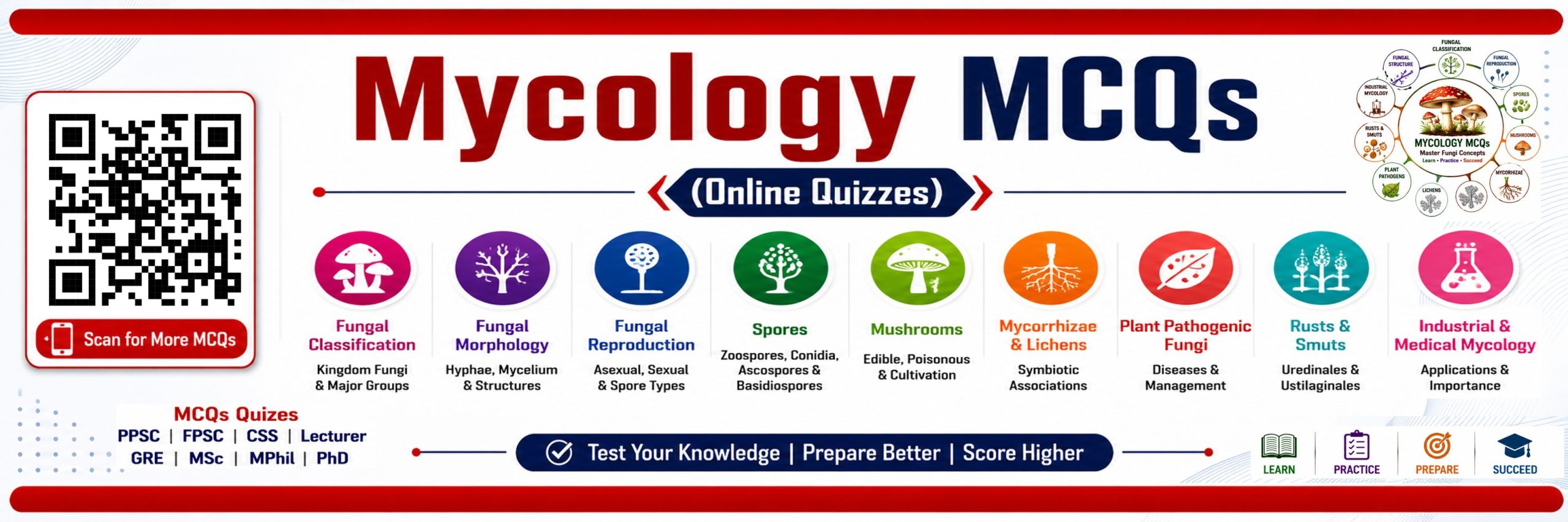
Mycology MCQs (Microbiology Quiz Series)
Multiple Choice Questions for Professional Test Preparation
[Explore all MCQs] [Microbiology MCQs] [Plant Pathology MCQs]
[Mycology MCQs] [Enzymology MCQs] [Food Science MCQs]
[Biology MCQs][Botany MCQs] [Zoology MCQs]
| [MCQ Quiz 1] | [MCQ Quiz 2] | [MCQ Quiz 3] | [MCQ Quiz 4] |
| [MCQ Quiz 5] | [MCQ Quiz 6] | [MCQ Quiz 7] | [MCQ Quiz 8] |
| [MCQ Quiz 9] | [MCQ Quiz 10] | [MCQ Quiz 11] | [MCQ Quiz 12] |
| [MCQ Quiz 13] | [MCQ Quiz 14] | [MCQ Quiz 15] | [MCQ Quiz 16] |
_______________________________________________
Mycology MCQs, Mycology objective questions, Important Mycology MCQs for Competitive Exams, Mycology MCQ Quizzes, Microbiology Quiz Series
[Soil Science MCQs] [Plant Nutrition MCQs] [Crop and Environment MCQs] [Soil Physical Properties MCQs] [Soil Chemical Properties MCQs] [Soil Organic Matter MCQs][General Agriculture MCQs] [Agronomy MCQs] [Plant Physiology MCQs]
What is Mycology?
Mycology is the branch of biology that deals with the scientific study of fungi. including their classification, morphology, physiology, reproduction, ecology, and economic importance. It covers yeasts, molds, mushrooms, rusts, smuts, and other fungal organisms.
What are fungi?
Fungi are eukaryotic, heterotrophic organisms that obtain nutrients by absorption (heterotrophic) and produce spores for reproduction.
What are the main characteristics of fungi?
Fungal organisms lack chlorophyll (they cannot produce their food), possess chitinous cell walls, reproduce by spores, and obtain nutrients through absorption.
Why are fungi classified as heterotrophs?
As fungi are heterotrophs, they cannot produce their own food; therefore, for nutrition, they depend on organic matter from other organisms.
What is the difference between fungi and plants?
Plants are autotrophs, i.e., they contain chlorophyll and can produce their own food through photosynthesis. Contrarily, fungi don’t have chlorophyll for food synthesis, and they absorb nutrients from organic sources.
What is the study of fungi called?
Mycology is the branch of biology that deals with the scientific study of fungi. including their classification, morphology, physiology, reproduction, ecology, and economic importance. It covers yeasts, molds, mushrooms, rusts, smuts, and other fungal organisms.
Who is known as the Father of Mycology?
Heinrich Anton de Bary, a 19th-century German botanist and microbiologist, is widely recognized as the Father of Modern Mycology. His work on complex life cycles of fungi and proving that specific fungal spores cause diseases in plants revolutionized the field.
Why are fungi important in nature?
Fungi are Earth’s main recyclers, involved in decomposition, bioremediation, carbon sequestration, and mycorrhizal symbiosis.
How do fungi reproduce?
Fungi reproduce through both asexual and sexual methods involving spores and specialized reproductive structures.
What is asexual reproduction in fungi?
In fungi, asexual reproduction occurs through spores such as conidia, sporangiospores, chlamydospores, or by fragmentation and budding.
What is sexual reproduction in fungi?
In fungi, sexual reproduction involves plasmogamy, karyogamy, and meiosis, resulting in genetically diverse spores
What is plasmogamy?
The word plasmogamy is derived from the Greek plasma (something molded or fluid substance/cytoplasm) and gamos (union). Biologically, it is the physical fusion of the cytoplasm (or protoplasm) of two separate parent cells or gametes. In fungi, plasmogamy is the fusion of cytoplasm from two compatible fungal cells.
What is karyogamy?
Karyogamy is derived from the words karyon (Greek for nut or nucleus) and gamos (Greek for marriage or union). Biologically, karyogamy is the fusion of the two haploid (1n) nuclei. In fungi, karyogamy is the fusion of two haploid nuclei to form a diploid (2n) nucleus.
What are the economic uses of fungi?
Fungi provide a diverse range of economic advantages across various sectors, including food, medicine, agriculture, and industry.
Fungi are used as nutritious foods: e.g., Mushrooms (Agaricus bisporus), truffles.
Fungi are used in the baking industry, e.g., Saccharomyces cerevisiae
Fungi are used in Brewing and alcoholic beverages, in wine and beer production
Considering medicine, fungi are used in antibiotics, pharmaceuticals and traditional medicine
In agriculture, fungi have diverse applications in soil fertility and plant growth improvement, decomposition, recycling, biopesticides etc.
What are the harmful effects of fungi?
Not all fungi are beneficial. Although many play essential ecological roles, harmful fungi cause significant damage to plants, animals, humans, and food systems through diseases, mycotoxins, and spoilage.
Fungi cause harmful effects through diseases (human/animal/plant diseases), Allergic & Respiratory Reactions, neurological disorders, plant crop damage, food spoilage, and the production of toxins to poison food, resulting in billions of dollars in economic losses and more than 1.5 million deaths annually across the world.
Fungi cause billions of dollars in annual economic losses through damage to crops and stored food; loss of food for human consumption; healthcare costs from fungal infections; food spoilage and waste, etc.
What is the role of mycorrhiza in agriculture?
In agriculture, the role of mycorrhiza is very critical. They form symbiotic relationships with most crop plants and significantly enhance uptake of macronutrients and micronutrients, improve soil water and nutrient holding capacities, water absorption, soil health, microbial diversity, carbon sequestration and plant resilience to environmental and biotic stresses.
_______________________________________________
Mycology MCQs, Mycology objective questions, Important Mycology MCQs for Competitive Exams, Mycology MCQ Quizzes, Microbiology Quiz Series
What is a hypha?
What is mycelium?
What is the difference between septate and coenocytic mycelium?
What is a haustorium?
What is a rhizoid?
What is a rhizoid?
What is a stolon?
What is a sclerotium?
What is stroma in fungi?
What are fungal spores?
What is a conidium?
What is somatogamy?
What is heterothallism?
What is homothallism?
What is a zygospore?
What is an ascospore?
How are fungi classified?
What are Phycomycetes?
What are Oomycetes?
What are Ascomycetes?
What are Basidiomycetes?
What are Deuteromycetes?
What are Chytridiomycetes?
What are slime molds?
What are true fungi?
What are imperfect fungi?
What is a mushroom?
Which mushrooms are edible?
Which mushrooms are poisonous?
What is Agaricus?
What is the pileus of a mushroom?
What is the stipe of a mushroom?
What are gills in mushrooms?
How are mushrooms cultivated?
What is mushroom spawn?
Why are mushrooms considered nutritious?
What diseases are caused by fungi?
What is rust disease?
What is smut disease?
What is powdery mildew?
What is downy mildew?
What is white rust?
What is late blight of potato?
What causes damping-off disease?
How are fungal diseases controlled?
What is mycorrhiza?
What are the types of mycorrhizae?
What are lichens??
_______________________________________________
Suggested Readings
Sutton, D.A., 2015. Basic Mycology, in: Hospenthal, D.R., Rinaldi, M.G. (Eds.), Diagnosis and Treatment of Fungal Infections. Springer International Publishing, Cham, pp. 11-23.
Lewis, R.E., A.W. Fothergill, 2015. Antifungal Agents, in: Hospenthal, D.R., Rinaldi, M.G. (Eds.), Diagnosis and Treatment of Fungal Infections. Springer International Publishing, Cham, pp. 79-97.
Sousa Silva, M., C. Cordeiro. 2024. New findings in metabolomics in food mycology. Current Opinion in Food Science 57: 101175.
Siddiquee, S., 2017. The Basic Concept of Microbiology, Practical Handbook of the Biology and Molecular Diversity of Trichoderma Species from Tropical Regions. Springer International Publishing, Cham, pp. 1-15.
Basic microbiology and metabolism
_______________________________________________
Mycology MCQs, Mycology objective questions, Important Mycology MCQs for Competitive Exams, Mycology MCQ Quizzes, Microbiology Quiz Series